This Blog is by Osbert E. Agho, a Benin City, Edo State based businessman and a prominent politician. On this blog, you will get first hand, and hard to find news items, commentaries and events happening around the World and Nigeria. News about the every day people and their environment. Enjoy reading news will uplift mankind.
FORMER president Dr Goodluck Jonathan has been given the Diplomatic Circles Honour Award for upholding human rights in Africa making him the first president from the continent to receive the global accolade.
Dr Jonathan, who will receive the honour in Geneva, Switzerland on January 21 next year at the group’s annual dinner, will also deliver the keynote address at the event. Diplomatic Circle, a group of global diplomats have decided to honour Dr Jonathan for his role in Nigeria's peaceful transition during the last elections.
Earlier this year, a public policy organisation on African affairs, the Africa Political and Economic Strategic Centre, had also nominated Dr Jonathan for the Nobel Peace Prize. It stated that the peaceful way he conceded victory to President Muhammadu Buhari in the general election as the reason that he deserves the attention of Nobel Peace Prize committee.
In addition, the group noted that although Dr Jonathan’s act might have not promoted fraternity between nations as required of a Nobel Peace Prize winner but he promoted fraternal peace among Nigerians by conceding power. Dr Jonathan prevented any rancour in Nigeria by conceding defeat to President Buhari after the last election, even before the results were announced.
ABUJA-BARELY 72hours after the conclusion of the supplementary governorship election in Kogi state, the deputy governorship aspirant to the Late Abubakar Audu, Abiodun Faleke who refused to deputise Yahaya Bello who succeeded late Audu in the election, on Tuesday, showed up in the House of Representatives, where he took part in the legislative business of the day.
Faleke
Faleke who rejected being declared governor-elect of Kogi State after the death of his principal, Prince Audu currently represents Ikeja Federal Constituency in the 8th House of Representatives where he also chairs the Committee on Customs and Excise.
The towering lawmaker stormed the green chamber spotting a white flowing ‘Agbada’ and a hand-made red cap, amid cheers from his colleagues in the House as he approached the chair where he held a brief chat with Speaker Yakubu Dogara before resuming to take his seat.
Faleke who rejected his re-nomination as deputy governorship candidate to the eventual winner and governor-elect, Alhaji Yahaya Bello has since gone to court asking the Judiciary to declare him governor-elect instead of Yahaya Bello whose name the All Progressives Congress (APC) forwarded to the Independent National Electoral Commission (INEC) as subtitle to the late Prince Audu.
In the suit, Faleke argues that both the INEC and the APC erred by, first, declaring the election inconclusive when the circumstances leading to cancellation of votes in most of the affected polling units bothered on over-voting and refusal to use card reader which amounted to violation of the electoral Act of 2010.
He is also faulting APC’s decision to substitute late Audu with Yahaya Bello when he (Faleke) who participated in all the stages of the election with the late candidate should have been the replacement as against Yahaya Bello who did not participate in all the stages of the election apart from the primaries where he came second.
His camp also accused Yahaya Bello of anti party activities during the inconclusive poll, saying that the latter worked against the interest of the APC which accounted for why the party even lost his own polling booth in Okene.
However, efforts to get views of lawyers concerning the legal implication of the development could not yield results as at press time.
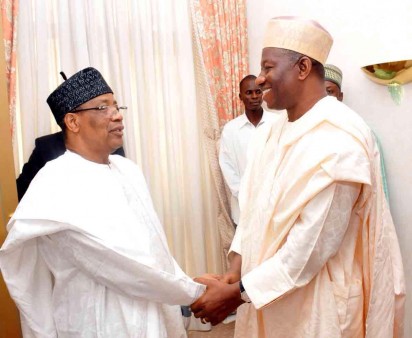
FORMER military president, General Ibrahim Babangida, has disagreed with critics of former President Goodluck Jonathan who described him as incompetent saying Jonathan was rather “inexperienced” rather than “incompetent.”
FILE PHOTO: EX-PRESIDENT GOODLUCK JONATHAN WITH FORMER PRESIDENT IBRAHIM BABANGIDA, DURING JONATHAN’S VISIT TO MINNA ON SATURDAY (27/12/14)
General Babangida who spoke with The Interview magazine in the December 2015 edition which is currently on sale argued that Jonathan who lost his re-election bid in March “is a very pleasant person” and that he believed the former president meant well for the country.
Asked about the perception that Jonathan is a good person but was “incompetent”, Babangida replied: “If you use inexperience, I will buy that.”
The retired general spoke on a wide range of issues, including the botched coup of 1990 and how his late wife, Maryam, woke him up in the middle of the night to alert him about the movement of troops at Dodan Barracks, which was the seat of power then. He denied that his life was saved by Sani Abacha, who was then the chief of army staff, and also denied reports that he hid in a bunker while the coup plotters were looking for him.
“They obviously didn’t have a lot of experience,” Babangida recalled. “It was during the fasting period. We were still in Dodan Barracks then. My wife got up from sleep and said she had noticed very unusual movement of troops from one end to the other. So she woke me up and said I should look through the window.
”I found troops moving from one end to the other. The next thing I heard was shooting going on. We tried to put a small party together. It was about 1.30am. Then the guards, the bodyguards said let’s check out of this place. I was a bit stubborn. I told them I was not leaving. It didn’t occur to me that we had a bunker at Dodan Barracks. We had, but it didn’t occur to me to use it. And so, they came. I said the only thing I would concede to, I would evacuate my family. My wife had her last born, who was just a few months old, with her. So they evacuated them to a safe house.
“So, I remained with a few bodyguards. We decided to get out and move around. We went to a safe house around Surulere. I had a bodyguard, Omuah. We just moved in there. From there, we established communication. I later established communication with Abacha, Raji Rasaki (who was governor of Lagos then) and the other. They had mobilised their troops.”
He maintained that “Abacha didn’t save my life in the Orkar coup. We worked together to crush Orkar’s coup.”
Social Media Bill: You are on your own, Buhari tells Senate
on
ABUJA — President Muhammadu Buhari, yesterday, distanced himself from the proposed Social Media Bill currently being debated in the Senate seeking to restrict Nigerians from “criticizing” political and public office holders.
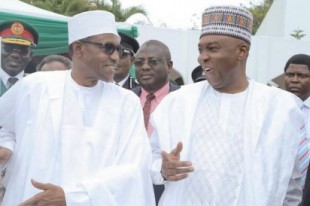
Muhammadu Buhari and Bukola Saraki
This is just as the United Nations is considering the petition filed by rights group, Socio-Economic Rights and Accountability Project (SERAP), against the bill
The President speaking through his Senior Special Assistant on Media and Publicity, Malam Garba Shehu, stated that the principle of the bill was inconsistent with democratic ideals of free speech enshrined in the constitution of the land.
He added that he had sworn to protect and uphold the dictates of the constitution and would not in anyway go against it.
President Buhari, however, stated that he was “not averse to lawful regulation, so long as that is done within the ambit of the constitution” which he swore to uphold, noting that free speech was central to democratic societies anywhere in the world.
“The President won’t assent to any legislation that may be inconsistent with the constitution of Nigeria,” he said.
He further explained that without free speech, elected representatives won’t be able to gauge public feelings and moods about governance issues.
“As a key component of democratic principles are so emotionally attached to free speech that they would defend it with all their might,” he said.
Shehu explained that President Buhari was fully aware of the public reservations about the proposed legislation but assured that there was no cause for alarm “because the Senate is a democratic Senate.
The bill, however, has passed second reading in the Senate.
UN hears petition on the bill
Meanwhile, the UN Special Rapporteur on the promotion and protection of the right to freedom of opinion and expression, Mr. David Kaye is considering the urgent appeal against the bill
In a statement, yesterday, by SERAP executive director, Adetokunbo Mumuni, the organisation said: “SERAP can confirm that the Office of the Special Rapporteur is now considering our petition. We have received communication from Marcelo Daher at the Office of the Special Rapporteur to this effect. The Special Rapporteur has also requested a copy of the bill, which SERAP has promptly sent to Marcelo Daher.
“SERAP appreciates the prompt attention to this matter by the Office of the Special Rapporteur. We urge the UN to pursue this matter to a satisfactory conclusion by ensuring that the Nigerian Senate is not allowed to strangulate media freedom and social media in the country,” the group said.
According to the group, “the only option for the Senate now is to withdraw this obnoxious bill without further delay and end this international embarrassment. SERAP will be prepared to withdraw the petition at the UN if the Senate can follow this honourable path.”
SERAP, last week, sent an urgent appeal to Mr. David Kaye requesting him to “use your good offices and position to urgently request the National Assembly of Nigeria, specifically the Senate, to withdraw a bill which if passed into law would undermine the internationally recognized right to freedom of expression and press freedom on the internet in the country.”
The urgent appeal
Mr Zeid Ra’ad Al Hussein, UN High Commissioner for Human Rights, was copied in the urgent appeal.
In the urgent appeal, the organisation expressed serious concerns “that the National Assembly of Nigeria will any moment from now pass a bill to jail for two years and fine anybody or group of persons who send any alleged false text message or post false message on the social media against another person.
“SERAP is concerned that rather than increasing universal and inclusive access to the Internet for all Nigerians, the National Assembly of Nigeria is working to undermine access of citizens to the Internet. Yet, freedom of expression entails the ability to both speak and receive information, including through the social media and other generated content services such as YouTube, Twitter, Facebook, and chat applications.
“By initiating this bill, the National Assembly is impermissibly restricting the ability of the citizens to use these tools to communicate, connect, and seek independent sources of information.
“SERAP also contends that the bill will restrain access to Internet and social media, curtail the freedom of the press, and online content in illegitimate, disproportionate, or otherwise unlawful and abusive ways. The real targets of the bill are social media and human rights defenders that might be critical of government policies or report on corruption involving high ranking government officials.
“International law provides that any restriction to rights online must be provided in law, pursuant to a legitimate aim, and limited to only what is necessary and proportionate. SERAP believes that the bill falls far short of international requirements of legitimacy, necessity and proportionality.
“The bill will also have chilling effect on freedom of expression in the country, as it will create an atmosphere of fear among bloggers and online activists who may not post critical commentary on Facebook or other social media platforms for fear of being sent to jail.”
Turkey's Prime Minister Recep Tayyip Erdogan, right, speaks with Russian President Vladimir Putin during arrivals for the G-20 summit at the Konstantin Palace in St. Petersburg, Russia on Thursday, Sept. 5, 2013. The threat of missiles over the Mediterranean is weighing on world leaders meeting on the shores of the Baltic this week, and eclipsing economic battles that usually dominate when the G-20 world economies meet. (AP Photo/Alexander Zemlianichenko)
Russian President Vladimir Putin has stepped up his attacks on Turkey's government. Tensions started flaring after Turkey shot down a Russian jet flying over Syria last month. Ankara says this step was taken because the jet violated Turkey's airspace and because its pilots ignored as many as ten warnings.
Although Washington has backed the Turks, Putin tells a completely different story. According to him, the plane didn't violate Turkey's airspace at all. He also says the pilots received no warning whatsoever, arguing that it was planned.
Ever since, Putin and Turkey's president, Recep Tayyip Erdogan, have been at loggerheads. Putin has ordered several economic sanctions against Turkey intended to hurt the country's economy. He has also accused the Turks of secretly buying oil from ISIS, thereby enriching the organization and enabling it to survive and even thrive in Syria and Iraq.
In his annual state of the nation speech to ministers, parliamentarians and other state officials broadcast on public TV channel Rossiya 24 last Thursday, Putin took his criticism of Turkey's government one step further. According to the Russian leader, the decision to shoot down the Russian jet proves that "Allah decided to punish the governing clique in Turkey by depriving them of sense and reason."
On Wednesday, Putin also criticized Turkey's Islamist leaders, saying: "We observe...that the current Turkish leadership, over a significant number of years, has been pursuing a deliberate policy of supporting the Islamization of their country." He added: "We ourselves support Islam and will continue doing so, but the point at issue is the support of a more radical branch. And that in itself creates a very unfavorable environment."
The accusation that Allah is punishing Turkey's government will undoubtedly not be appreciated by Turkey's Islamist leadership. President Erdogan is a devout Muslim who, as the Daily Mailreported earlier this year, "is increasingly touting himself as a leader" of the Islamic world. It is to be expected, then, that Turkey in turn will also step up its rhetoric in the days and weeks ahead. This means that a resolution to the crisis between the two regional powerhouses seems further away than ever.
Want more news? Sign upfor free newsletters to get more of the AJC delivered to your inbox.
Former President Jimmy Carter said Sunday his cancer is gone.
Carter said in a statement that his most recent MRI brain scan did not reveal any signs of the original cancer spots or any new ones and that he’ll continue his treatment.
Former president Jimmy Carter waves to the crowd watching the Plains Peanut Festival parade in late September. While teaching Sunday School today, Carter said his most recent scan last week showed his cancer was gone. AJC photo by Ben Gray
“He said he got a scan this week and the cancer was gone,” Jill Stuckey said by phone from Maranatha, where Carter was still in the midst of teaching to about 350 people, many of them visitors. “The church, everybody here, just erupted in applause.”
Even one of Carter’s closest friends had no idea the news that was coming — which only added to her sense of gratitude as the news filled the little church.
“It’s like getting the biggest Christmas gift that you could ever want,” said Jan Williams, who spends the hour before Carter’s class humorously instructing visitors on the do’s-and-don’ts of being around their famous teacher. “This week was just horrible in the world in terms of all the bad things happening. How wonderful in the midst of all this to get such wonderful, encouraging news.”
Carter’s grandson, James Carter, confirmed that a recent test showed his grandfather was cancer-free.
“There’s no cancer in his body at this point,” said James Carter. “He’s not going to stop doing the treatment, but at this point, there’s no cancer. It’s incredible news.”
“See?” he added. “I knew he wasn’t really human.”
Or as his friend, Williams, put it: “I never felt God was through using Jimmy Carter yet. He’s done what the doctors told him to do, and what an example that is for the rest of us.”
Carter’s doctors at Emory University’s Winship Cancer Institute, deferred all requests for comment to the Carter Center on Sunday. Meanwhile, one expert who is not involved in the former president’s treatment cautioned that this latest bit of good news doesn’t mean he is cured or is totally cancer-free.
“It doesn’t mean that there is no cancer in his body; it means that there is no indication that they can find cancer for the present,” said Dr. Len Lichtenfeld, deputy chief medical officer for the Atlanta-based American Cancer Society, who stressed he was speaking about cancer in general.
While the scans of Carter’s brain and liver show no signs of the disease, cancerous cells could still be in his bloodstream, said Lichtenfeld. Still, he said, the news is encouraging for Carter.
“The President has done exceptionally well. There are still many patients with melanoma who don’t have this outcome,” said Lichtenfeld. “He’s in the best possible place.”
And yet, only a few years ago, Stage IV melanoma was tantamount to a death sentence, and it still is a very difficult disease for many.
Outcomes for the illness began to change as few as five years ago, when drugs that rally the body’s own immune system to fight the disease began to show promise.
And, one of Carter’s physicians at Winship Cancer Institute of Emory University, Dr. David Lawson, happened to be one of several researchers at sites around the country who were studying the effect of these drugs.
These so-called immunotherapeutic drugs have shown great promise in treating melanoma. Lawson was involved in studies that resulted in approval of the drug Yervoy in 2011. Since then, several others also have been approved by the FDA, including the drug, pembroluzimab, that Carter has been treated with since August.
At a Habitat for Humanity build in Memphis last month, Carter said he had completed his round of four treatments and was feeling good. A week later, the Carter Center released what it termed a “good news” statement, in which it said his doctors at Emory University’s Winship Cancer Institute had told their famous patient that recent tests had shown no evidence of new malignancy and that he was “responding well to treatment.”
(A spokeswoman for Emory and Winship said Sunday that all inquiries were being referred to The Carter Center and no experts would be available to discuss this lastest news.)
Back in Plains, meanwhile, no one appeared to be holding back. The mood around town was one of “elation,” said Plains Trading Post owner Phil Kurland. Someone who’d been at Maranatha for Sunday School didn’t stay around for the church service, and instead came into the political memorabilia store on Main Street to relate what Carter had said. And people kept streaming in later in the day to express their wonder, and in some cases, slight apprehension.
“Apprehension in that they’re hoping (the news) stays good,” Kurland explained. “Certainly, though, the feeling is it’s a happy surprise.”
Even before this latest piece of good news, the former president was upbeat and active. Another Carter grandson, former state Sen. Jason Carter, said Wednesday during an address to the Atlanta Press Club that his grandfather was doing well physically, emotionally and mentally. Jason Carter took the job as the chair of the Carter Center after his grandfather said his cancer would force him to take a step back from his day-to-day duties.
“There’s been no evidence of that at all,” the younger Carter quipped.
Staff writer Greg Bluestein contributed to this report.
LAGOS, Nigeria — The thieves were having a field day, the comedian Ali Baba exclaimed to a large auditorium of lawyers. It was so bad that they struck every car along a deeply potholed road — that is, until a former governor came along.
“They looked at him, and said he should drive on,” he said as the crowd grew silent. “The other armed robber said: ‘Why? Why did you let that car go?’ ”
“ ‘Esprit de corps’ ” — a camaraderie among brothers — he said, delivering the punch line and unleashing roars of laughter throughout the audience.
Forget crooked politicians, daily blackouts, long lines at gas stations or even the scourge of Boko Haram here in Nigeria, Africa’s most populous nation. Despite the litany of social ills and troubles — or maybe because of them — Nigeria has never laughed harder.
Comedy here is thriving. Top comics have become, in a few short years, among Nigeria’s most successful entertainers and now perform throughout Africa.
Stand-up comedy, which emerged with Nigeria’s return to democratic rule in 1999, has become the country’s third-biggest form of entertainment after movies and music, industry experts say. It now draws countless aspiring comics to thriving comedy scenes in medium-size cities and to the country’s center of laughter here in Lagos.
Photo
Comics outside a showcase in Lagos, Nigeria, in October.CreditGlenna Gordon for The New York Times
“Nigerians still go through all kinds of trauma in their daily lives because of the comatose nature of our leadership,” said Ezechi Onyerionwu, a literature professor who has written about comedy. “So people look for areas in life where they can find succor, and that’s why comedy shows are sold out.”
So quickly has the art form caught on that stand-up comics have become fixtures at social events, like the lawyers association that hired Ali Baba for its dinner here recently. Securing a talented comic for a wedding, company event or political gathering has now become de rigueur in Nigeria’s higher social circles.
“Ten years ago, you had masters of ceremonies who would just run a program and put in some lighthearted talk that would make people smile,” said Barclays Ayakoroma, a cultural critic who has written about the rise of stand-up comedy in Nigeria. “But today, depending on how deep your pocket is, you must get a good stand-up comedian for your event. Today, there is hardly any function that you will not see a stand-up comedian coming in and performing during interludes. It’s a common practice nationwide.”
Stand-up comics — rib crackers or humor merchants, as they are also called here — tap into the nation’s enduring ability to find laughter in the bleakest moments, sometimes in its collective misery itself.
Julius Agwu, another top comedian, makes fun of the frequent power blackouts, part of every Nigerian’s daily life, through a joke about a Nigerian man who travels to London for the first time.
“When he arrived, he just brought out all his clothes and started ironing them,” Mr. Agwu says. “His uncle that he was staying with asked: ‘What’s wrong? Why are you ironing your clothes. Where are you going to?’ He said, ‘No, I want to rush before they take the light.’ ”
Working in such public spheres, the comedians are challenging deeply rooted social and political mores. Socially, Nigeria remains an extremely hierarchical country where powerful individuals are treated with fawning respect. For the second time since military rule ended in 1999, Nigeria finds itself governed by a former general, President Muhammadu Buhari, evidence of the military’s lingering influence.
Basketmouth, another leading comedian, was fiercely attacked recently for making jokes about embezzlement in the previous government. The jokes were uploaded online and drew criticism from the former governing party and its supporters. The comedian, whose real name is Bright Okpocha, was accused of tarnishing Nigeria’s image.
Photo
Atunyota Alleluya Akporobomerere, whose stage name is Ali Baba, is a comedy pioneer in Nigeria.CreditGlenna Gordon for The New York Times
“I can stay away from religious jokes,” Mr. Okpocha, 37, said, “but I’m not going to stay away from political jokes. It’s something that affects the common man and nobody is speaking on their behalf. Inasmuch as I definitely have to limit myself so that I can live longer, I can’t see a truth and not say it.”
Theater was popular here in the 1960s and 1970s, but to most Nigerians, stand-up comedy was unknown when the present era of civilian rule began.
“During military rule, you couldn’t go and start cracking jokes about the head of state,” said Mr. Ayakoroma, the critic. “That night, they would have come for you. So we can say that civilian rule opened the way for people to make jokes about our leaders without fear of being arrested.”
Ali Baba, whose real name is Atunyota Alleluya Akporobomerere, is considered the pioneer of stand-up comedy in Nigeria. Now 50, he recalled how, with no Nigerian models to emulate, he researched the distinctly American art of stand-up comedy by combing through old copies of Reader’s Digest and reference materials like “10,000 Jokes, Toasts and Stories.”
“You see how used it is,” he said, holding up the book.
He also frequented an information center run by the American government, studying its videos of Eddie Murphy and Richard Pryor.
Then, he got help from an unexpected source: Olusegun Obasanjo, a former general who became Nigeria’s civilian president from 1999 to 2007.
When Mr. Obasanjo was Nigeria’s military ruler between 1976 and 1979, he had shown little tolerance for criticism. After Fela Anikulapo-Kuti, the Afro-beat musician and activist, criticized the military in a song called “Zombie,” Mr. Obasanjo’s soldiers burned down his house and killed his 77-year-old mother.
Photo
Bright Okpocha, known as Basketmouth, is another top comedian.CreditGlenna Gordon for The New York Times
But under democracy, Mr. Obasanjo championed comedians like Mr. Akporobomerere, who roasted him regularly, and recommended him for performances.
Mr. Akporobomerere’s success helped popularize other comedians and bring stand-up comedy into the mainstream.
“Companies wanted to use our services, and young people wanted to take up comedy as a career,” said another popular comedian, Okey Bakassi, whose real name is Okechukwu Anthony Onyegbule. “That changed everything.”
“There are certain people in government who do not have a sense of humor,” Mr. Akporobomerere said.
Sometimes he texts jokes to politicians with whom he has built a relationship to gauge their response before using the material.
As comedians have become powerful, some politicians have come to understand the benefits of serving as comic material. Being the subject of a joke can be proof of the politician’s power or of ties to an influential comic.
“Some of them will come up to me and say, ‘Talk about me,’ ” Mr. Agwu said. “It’s like hype for them.”
Mr. Buhari may not be one of them. Known for his seriousness, he used his first Independence Day address, on Oct. 1, to criticize his countrymen for being “unruly.” As a military ruler in the 1980s, General Buhari waged a campaign called “War Against Indiscipline.” Nigerians were forced to form orderly lines at bus stops and other places under the gaze of the police and whip-wielding soldiers.
“So far, he’s not known as a type that will host parties,” said the comedian known as Basketmouth. “He’s a pretty serious guy, which is what we need for now. We don’t need to party. We need to fix the country right now.”

 FORMER president Dr Goodluck Jonathan has been given the Diplomatic Circles Honour Award for upholding human rights in Africa making him the first president from the continent to receive the global accolade.